Simon Wachieni, the founder of Maji Agri Solutions attributes the progress of his climate-innovative enterprise to the power of social media. Since the inception of his company that installs water ponds that harvest up to 10 million liters of water, he has gotten more than 100 customers from his Facebook, Twitter, LinkedIn, and WhatsApp platforms.
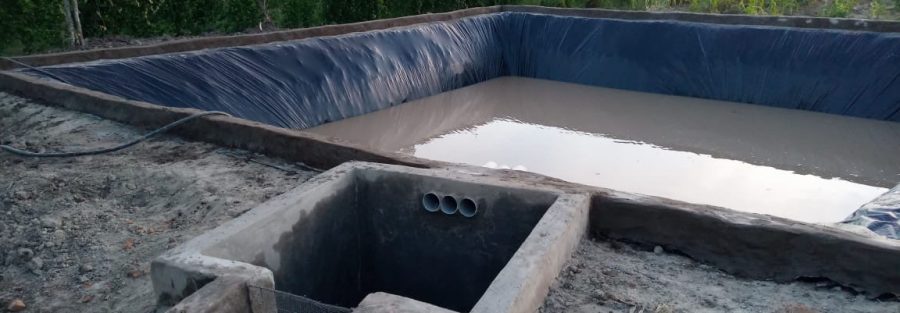
Maji Agri Solutions was established to address the challenge of water shortage, especially during dry spells. It is a company that installs water ponds of different capacities for domestic and commercial use. The company has until now impacted lives of hundreds of households by offering them and their neighbors a reliable source of water both for farming and consumption by livestock. The most recent installation is a 5.8 million litre capacity pond in Kajiado.
“Basically, I get almost all my clients from social media or referrals by people who spot my work on social media,” Simon says. “This customer is one of them.” His client in Kajiado is a farmer who had previously tried in vain to drill a borehole and suffered huge losses in the process. The customer, a farmer, got wind of the work that Maji Agri Solutions was doing and contacted Simon. Maji Agri excavated less than a quarter acre of land then installed a water harvesting system.
“This system will collect enough water during the rainy season and it will serve this farmer and his neighbors until the following season,” Simon says, adding, “No amount of water will be lost through percolation and only 10% of the water harvested will be lost through evaporation which is quite negligible given the amount that we are collecting.”
The water that is harvested is used for irrigation. Maji Agri Solutions has managed to advise the customers on the best irrigation systems and given recommendations on where to get them affordably. “The irrigation system that we shall use with this particular water pond in for instance is a form of drip irrigation that will use only two liters of water a week to grow 10,000 vegetables on an acre of land,” he notes. “You can imagine how much water will be left for the livestock and the farmer can even engage on other practices like fish farming.”
Simon has been training his customers on the best farming methods and advising them to plant trees around the ponds to act as wind breakers. “The trees around here not only reduce the rate of evaporation but are also an important component of agribusiness and will eventually be used as a source of revenue in the future,” he explains.
As Simon seeks to expand his market to include more farmers and institutions of learning, he is grateful to Kenya Climate Innovation Center (KCIC) which enrolled him into the incubation programme. “At KCIC I have learned numerous things and most importantly branding and communication, market penetration strategies and business development,” he affirms.
Kenya Climate Innovation Center (KCIC) incubates entrepreneurs with innovative solutions to address the impact of climate change around the fields of water management, renewable energy, agribusiness, waste management, energy resilience, and commercial forestry.